
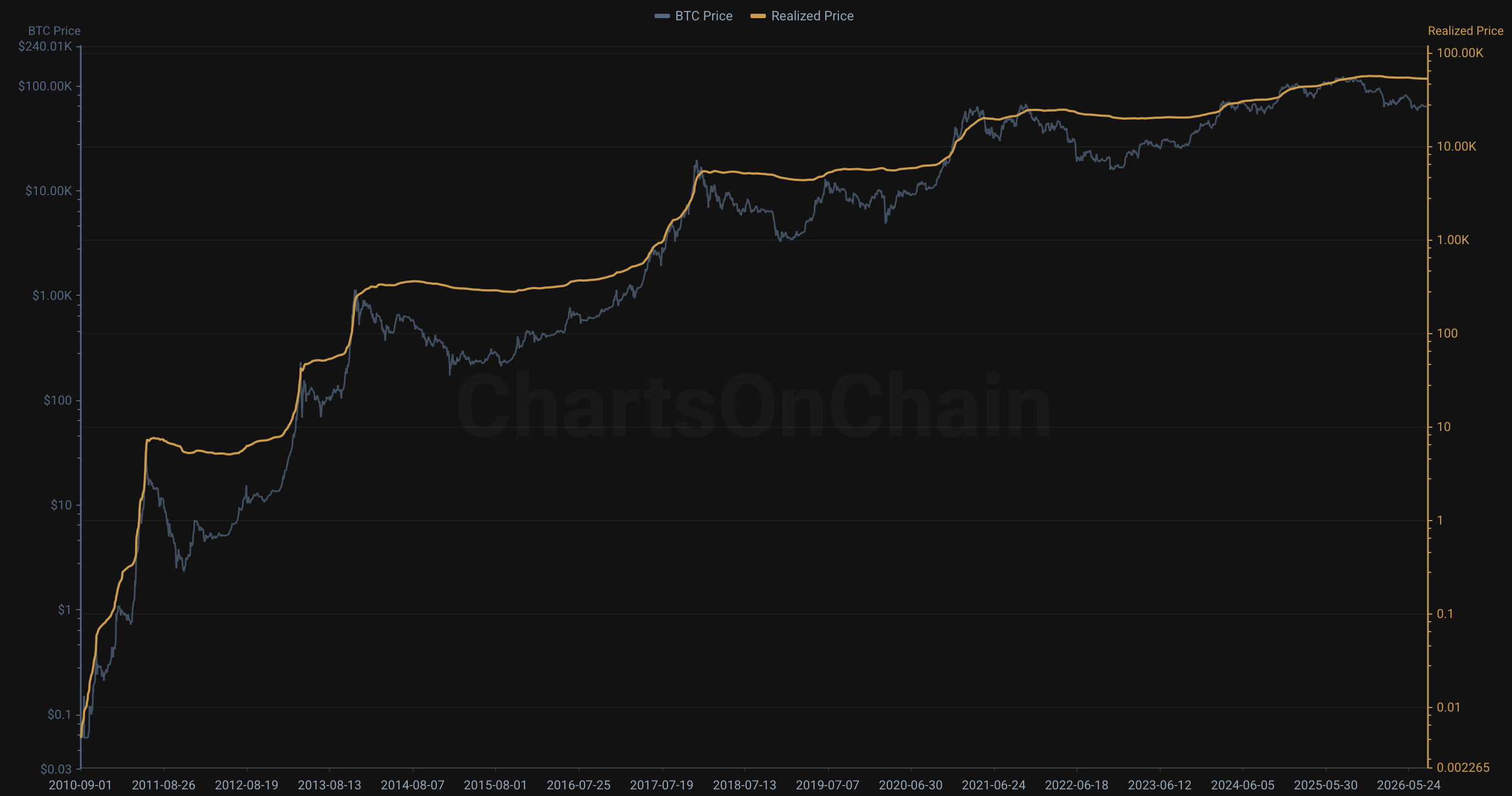
Bitcoin Realized Price is often incorrectly interpreted as the total cost basis (amount paid) of the market. This is not the case.
Although Realized Price uses a calculation based on a cost, it uses the market price at the time of on-chain movement, not the amount paid to acquire bitcoin by any one particular investor.
The metric represents a value for every unspent output in the current UTXO set defined by the price of bitcoin at the time this particular output was created on-chain.
From Realized Cap To Realized Price
By definition, Realized Cap assigns a value to each unspent output proportional to the price at the time this particular output was created on the blockchain.
Thus if 1 bitcoin last moved at the price of $20,000 and another last moved at $60,000 – their combined value equals $80,000 – regardless of the price today.
Realized Price is Realized Cap divided by circulating supply, visualized as a per-bitcoin value, serving as a valuable reference point for the network value from the perspective of aggregate realized value.
Unlike Market Cap which essentially uses the same price for all bitcoin in circulation – Realized Cap defines value for each unspent output individually, based on the price at the time this output was created. The larger the difference between the price at the creation of a certain output and the current price – the higher is the discrepancy between Realized Cap and Market Cap for this particular output.
A coin movement resets its realized value
The most important caveat to understand about realized value is that any on-chain movement of a bitcoin resets its realized value.
Spend a UTXO and create new outputs – and those new outputs’ realized value will be set according to the price at which the transaction settled.
Now, it could be argued that a particular transfer does not represent any economic change in custody.
In any on-chain transfer – even between two custodians controlled by the same entity – the bitcoin’s realized value will be reset according to the settlement price.
This is especially important to note in the context of calculating Realized Price – the metric that estimates cost basis.
At any given moment, the network only observes settlement of bitcoin on chain, and cannot account for economic ownership beyond direct on-chain spends.
As such, it is always possible that a bitcoin’s realized value will be lower or higher than its true cost basis in many contexts.
A custodian holding coins in one wallet address spending them to another can represent a bitcoin’s entire realization history from the perspective of the blockchain.
Economic ownership can change without Realized Price changing
Meanwhile, economic ownership can change without any on-chain activity occurring.
If an investor buys bitcoins on an exchange, they will often receive an account balance representing those coins, while the UTXOs themselves will remain on the custodian’s balance.
The new ‘owner’ possesses an account claim, but the economic custodianship of the coins still lies with the exchange – and so does the realized value assigned to the underlying UTXOs until they move on-chain.
Same goes for other custodial protocols, settlement systems, and centralized exchanges – in essence, any system where transaction settlement occurs off-chain first. In this way, Realized Price better represents on-chain settlement history than economic ownership in many cases.
Why is it termed a cost basis?
With those caveats said, realized value has proven to be a remarkably consistent metric.
Most bitcoin transactions on-chain are value motivated and if not, they are typically small movements between custodians at the edges of the ecosystem.
At a macro level, the distribution of value within the UTXO set at any given point approximates the value of bitcoin according to the price at the time of the transaction that put it there.
It is this consistency that makes the metric particularly compelling.
A price of $52,000 does not mean the average investor paid exactly $52,000 for bitcoin; it roughly equals an average realized value of $52,000 per bitcoin for the entire UTXO set, according to this metric. This is an important nuance when it comes to interpretation. In short, the Realized Price represents the value of the UTXO set at the time of each transaction, resetting every time coins move on-chain, regardless of the reason for the transaction.
What happens when market price crosses Realized Price
When Bitcoin’s price crosses Realized Price, it means the market value of bitcoin is either above or below the aggregate value of coins on the basis of their last known realized value on-chain.
This makes the comparison an objective observation once the methodology and price data used are fixed.
The subjective analysis begins when attempting to interpret what that observation might mean for the typical bitcoin investor.
A price below Realized Price does not necessarily indicate that investors are realizing losses, taking profits, or reaching any meaningful price level.
It only demonstrates that the price is below the value of the UTXO set on average, according to the price at the time of settlement for each bitcoin.
This perspective can be invaluable in analyzing market dynamics, since it puts the value of bitcoin in context relative to the UTXO set and its value history without relying on any particular assumptions about future price changes.
Other metrics inherit the same assumptions
Many other on-chain metrics rely on similar calculations when attempting to evaluate bitcoin’s price relative to the market.
MVRV, for example, uses an aggregate Market Cap versus aggregate Realized Cap comparison to evaluate current market value relative to aggregate realized value.
Metrics such as NUPL utilize similar variations of the same concept to calculate net unrealized profit and loss.
In the case of Supply in Profit and Loss, comparisons between current market price and realized value are used to observe which portions of the supply are in profit or loss.
Similarly, Short-Term Holder and Long-Term Holder Realized Price attempt to observe realized value pertaining to specific portions of the supply, though those segments are also defined by on-chain movement dates rather than investor intent.
The useful interpretation
Realized Price is most useful when discussed at the same level of aggregation at which it is calculated.
It is a metric that effectively summarizes the aggregate realized value of Bitcoin's current UTXO (unspent transaction output) set.
It can demonstrate how this value changes with transactions settling on-chain, how current market price differs from this value, and how different portions of BTC supply are positioned relative to each other, based on the same method of calculation.
However, it cannot effectively demonstrate the individual cost basis of any particular holder, the reason why any particular BTC was moved, or any change in an investor's position that is not settled on-chain.
Therefore, calling it an on-chain cost basis is a reasonable simplification.
However, interpreting this characteristic as the cost basis of any particular investor is incorrect.